
|
|
 Arts and Crafts
| The complex patterns of the weave are passed on from older members of the tribe to younger ones. It requires a high degree of skill to make such baskets, which have be strong and hard-wearing in order to carry heavy loads of wood, rice, or forest fruits. | 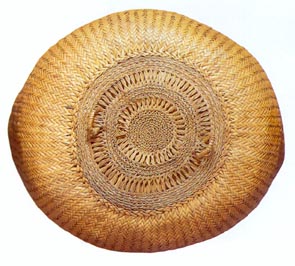 Basket - Before 1913, Dayak, Borneo - Museum fur Volkerkunde, Munchen. |
Carved:
| After every festival of the dead the sacrifial stakes from the main square are set up next to approppriate ossuary. They thus stand in isolation in the landscape. As they are carved from ironwood, they have a long life, though of course they lose their color. The style of the figures is very individual, as every sapundu carver is free to use his own imagination. | 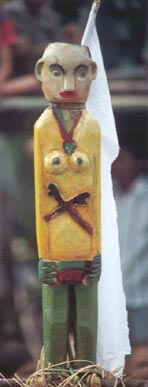 Sapundu carved from ironwood - Malahui, Central Kalimantan. |
| This ossuary belongs to the Tojoib Pandji family, the founders of the long house in Tumbang Malahui. Only the members of the family are allowed to be interested in this ossuary. Whenever family members sacrifice a buffalo at a festival of the dead, its bones are hung up on the ossuary in remembrance. The colors of the ossuary are renewed at each festival of the dead. | 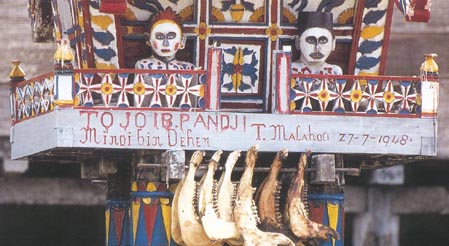 Ossuary, sandung - Ironwood, Tumbang Malahui - Central Kalimantan, Borneo. |
| Some carvers started producing highly stylised and elongated figures, and the wood was sometimes left with this natural finish. Others carved delightful animal figures, some totally realistic, some complete caricatures. Mores styles and trands developped: whole tree trunks carved into ghostly, intertwined "totem poles"; and curiously exagerated and distorted figures. | 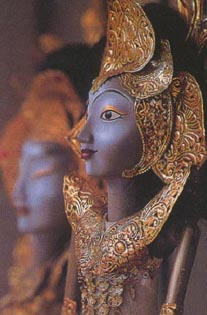 Wayang golek puppet - Bali. |
| Mask making is a specialised form of woodcarving, and only experts carve the masks used in so many theatre and dance performances. A particulary high level of skill is needed to create the 30 or 40 masks used in the Topeng dance. The mask maker must know the movements that each Topeng performer uses so that the character can be shown by the mask. | 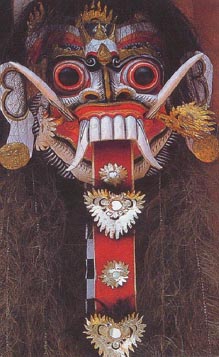 Mask Carving - A ceremonial mask - Bali. |
Weaving:
| The design on this ceremonial mat, which is used during ceremonies for the dead, depicts the next world, where the dead live. In the center is the tree of life, growing on golden sand. The bird's flying in the air are probably the mythical Piak Liau, which live only in the village of the dead. The houses and seats are symbols of a regal life in the next world, a life without work and everyday cares; above them fly flags and ceremonials umbrellas. | 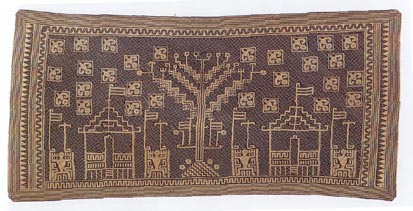 Ceremonial wall mat - Before 1963, wowen rattan, Kuala-Kapuas, Borneo, Staatliches Museum fur Volkerkunde, Munchen. |
| Batik: Traditional batik sarongs are handmade in central Java. Watch out for "batik" fabric which was actually been screen printed factories. The colours will be washed out compared to the rich colour of real batik cloth, and the pattern is often only one side (in true batik cloth, the dye penetrates to colour both sides). |  Batik -Bolts of batik cloth for sale display the bright hues to this style of traditional Javanese weaving. |
| Ikat: In various places in Indonesia you will find material woven by complex ikat process, where the pattern is dyed into threads before the materials is woven. Ikat usually involves pre-dyeing either the warp threads, those stetched on the loom, or the weft threads, those which are woven across the warp. The results of the pattern is geometric and slightly wavy, like a badly tuned TV. Its beauty depends on the complexity of the pattern and the harmonious blending colours. Typically the pattern is made in colours of similar tone - blues and greens; reds and browns; or yellows, reds and orange. Ikat sarongs and kain are not everyday wear, but they are not for strictly formal occasions either. | 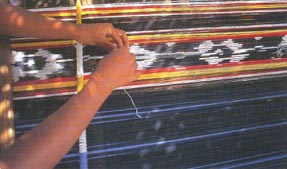 Ikat - The traditional ikat method of weaving in which pre-dyed threads are woven on a handloom. |
| Songket: A more elaborate material, for ceremonial and other important uses, songket cloth has gold or silver threads woven into the tapestry-like material, and motifs include birds, butterflies, leaves and flowers. Songket material is used for kamben, kain, and sarongs worn exclusively for ceremonial occasions. |  Songket - An example of the songket method of ikat weaving, which employs metallic threads of silver and gold. |
Keris:
| A keris is a curved or straight dagger with an engraved damascene blede finely carved hilt; it is confined exclusively to the southeast asian archipelago. The older shapes of keris are described as keris Majapahit and keris buda. Every respected family possessed a keris to which supernatural powers were ascribed, and the keris was considered one of the sacred objects (pusaka) of a family, clan, dynasty, or even kingdom. Such a keris was passed on from father to son and had always to be taken care of, in other words regularly honored with a purification ritual and sacrifices. | 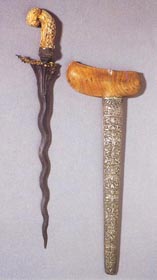 Keris with sheath - before 1917, ivory, silver, metal, gold; Java - Staatliches Museum fur Volkerkunde, Munchen. |
| Great technical skill was needed to make a keris. Trough the frequent folding together of bars of iron, or iron containing nickel (original meteoric iron), blades of up to 100 layers of metal were produced. approximately 5 kilos (11 pounds) of iron, 50 grams (1.8 ounces) of nickel, and 0.5 kilos (over 1 pound) of steel were needed for one keris; yet when made, a keris weighed around 0.4 kilos (1 pound). Through the folding, turning, chiseling, and filing of the iron and steel, a distinctive pattern (pamor) emerged that had a symbolic meaning. there are approximately 20 different named and recognized pamor. | 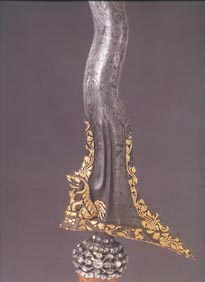 Blade of a keris - before 1937, steel, inlaid with nickel (pamor), semi-precious stones, diamonds, gold, overall length 47.5 cm; Java - Staatliches Museum fur Volkerkunde, Munchen. |
Wayang:
| The word wayang is often said to derive from the Malaysian word bayang ("shadow"). The fact that the word is malaysian suggests that the shadow plays are indigenous, and were iported from another culture. It also seems reasonable to assume that this art was linked to ancestral worship: in it, the shadows, which are assigned a supernatural role, are supposed to personify ancestors. However, this theory is somewhat unconvincing when we consider that the High Javanese and Balinese word for wayang ringgit, does not mean shadow but "dancers", "theater", or "figure". In addition, the fact that particular colors are used to characterize the figures shows that it is not only the shadow that is important far the production. | 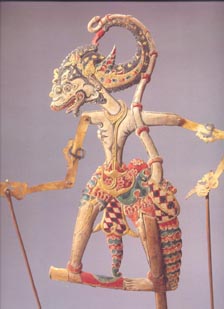 A wayang klitik puppet of Hanoman - before 1894, wood and buffalo leather; Java - Staatliches Museum fur Volkerkunde, Munchen. |
| The intricate lace figures of shadow puppets are made of buffalo hide carefully cut with a sharp, chisel-like stylus and then painted. The figures are completely traditional - there is no deviation from the standard list of characters and their standartised appearance, so there is no mistaking who is who. The noble characters are altogether more refined - they included the terrible Durga and the noble Bima. Wayang kulit stories are chieftly derived from great Indian epic poems, the Mahabharata and the Ramayana. | 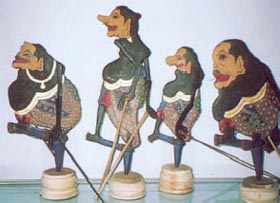 A wayang klitik puppets of (left to right) Semar, Petruk, Gareng and Bayong - Wood and buffalo leather, in a workshop in Yogyakarta. |
| The distinctive fingernail, kuku pancanaka, is a sign that Hanoman is a son of Bathara Baya (the god of the wind). The fingernail possesses a supernatural power that in battle allows Hanoman to kill his enemies. | 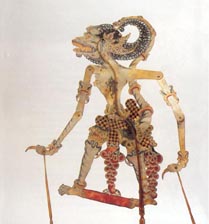 A wayang kulit puppet of Hanoman - before 1890, buffalo leather, buffalo horn; Java - Staatliches Museum fur Volkerkunde, Munchen. |
| Bima, like Hanoman, had a magical fingernail. The black face symbolizes perfection and wisdom. This can be ascribed to the fact that the color black is a mixture of all colors, and thus stands for the harmonious coming together of all virtues. | 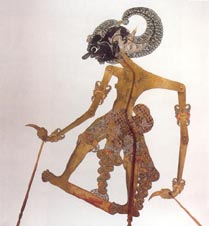 A wayang kulit puppet of Bima - before 1890, buffalo leather and horn; Java. Staatliches Museum fur Volkerkunde, Munchen. |